Garage Conversion Cost in Sacramento (2026): What You Pay For and What State Law Waives
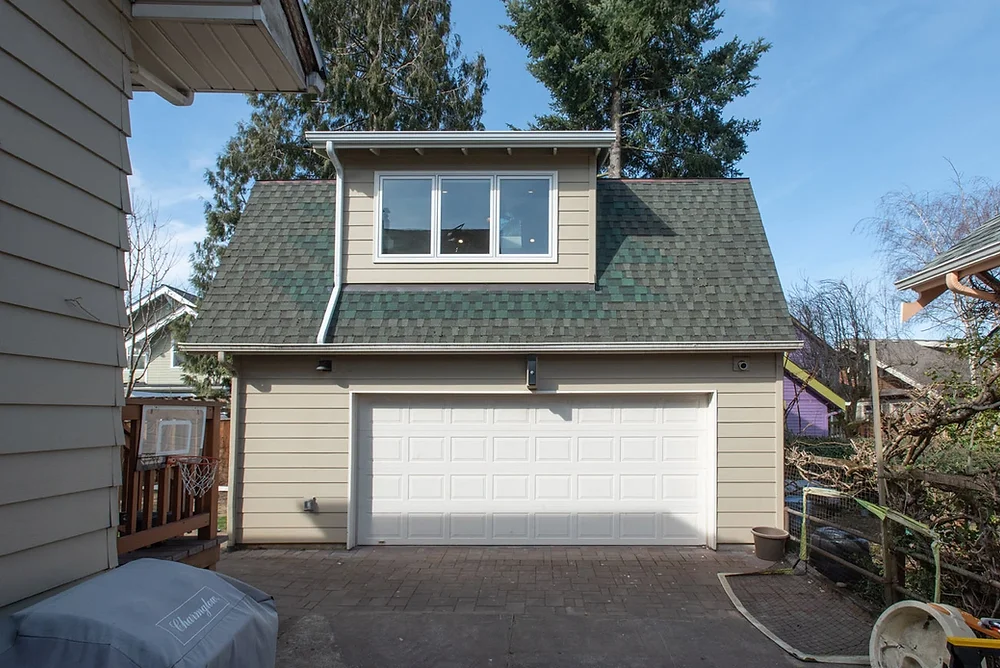
A garage conversion is usually the least expensive way to add a full ADU in Sacramento, because the slab, walls and roof are already standing. What you pay for is everything that turns a garage into a place someone can legally live: insulation, windows, a kitchen and bathroom, heating and cooling, and the inspections that sign it off. This guide covers what that costs, which rules work in your favor, and the items that make one conversion cost more than another.
The short answer
- Our published starting price for a permitted garage conversion into a self-contained living unit is $108,000. Size, plumbing distance and finishes set the final number.
- For a statewide reference point, the UC Berkeley Center for Community Innovation survey of California ADU owners (published April 2021, units permitted in 2018 and 2019) found a median of $90,000, or about $189 per sq ft, for garage ADUs, against $180,000 and $300 per sq ft for detached ADUs. Those are pre-2020 prices; use them to compare types, not as a quote.
- State law removes three costs a new build can carry: replacement parking, a new utility connection fee and, for a unit inside the existing structure, the setback requirements a new building would face.
Why a conversion costs less than a new ADU
In the same 2021 survey, garage conversions were the cheapest ADU type to build statewide, both in total and per square foot. The reason is structural: a detached ADU needs a new foundation, frame and roof plus utility lines run across the yard, while a conversion reuses all three and usually sits close to the main house's sewer, water and electrical service.
| ADU type (CCI survey, 2021) | Median total cost | Median cost per sq ft |
|---|---|---|
| Detached | $180,000 | $300 |
| Addition | $150,000 | $250 |
| Garage (conversion or built onto a garage) | $90,000 | $189 |
| Conversion of space in the main house | $100,000 | $173 |
The survey's authors note that some garage figures may be low because part of the owners were legalizing garages that had already been converted. A full conversion from a bare garage, with a new kitchen and bathroom, sits above that median today.
What the money goes into
Energy code work
The California Energy Commission treats converting an unconditioned garage into an ADU as an addition under the 2025 Energy Code, in effect for permit applications from January 1, 2026. In practice that means insulating the ceiling and walls to the levels the code sets for additions, energy-compliant new windows, and a heat pump for any new heating system. It also means no solar requirement: the Energy Commission states that solar PV applies to newly constructed ADUs and does not apply to additions or alterations.
Making it a legal living space
- Ceiling height: habitable rooms need at least 7 feet; bathrooms and laundry rooms at least 6 feet 8 inches (City of Sacramento summary of the 2025 California Residential Code). Most garages clear this, but a low beam or a sloped slab can change the layout.
- Bedroom escape window: every sleeping room needs an emergency escape opening of at least 5.7 sq ft (5 sq ft at grade floor), at least 24 inches high and 20 inches wide, with a sill no higher than 44 inches. This is often the reason a garage needs a new window opening cut into a wall.
- The garage door opening is framed in and finished as wall, usually with a window or door, which is one of the visible line items in any estimate.
- If part of the garage stays a garage, the City's code summary requires at least 1/2-inch gypsum board on the garage side, a self-closing, self-latching door between the garage and the living space, and no garage door opening directly into a bedroom.
Plumbing, kitchen and bathroom
This is where conversions differ most. A kitchen and bathroom placed along the wall nearest the main house's sewer line need a short trench through the slab; the same rooms on the far side of the garage need a long one. Asking where the sewer line leaves the house is one of the most useful questions at a first site visit.
Electrical
A unit with its own kitchen, heat pump and water heater adds real load. Whether the existing panel and service can carry it depends on what the house already runs, so it is checked before the design is final rather than at plan check.
Rules that lower the cost
- No replacement parking. When a garage is converted into an ADU, state law says the City shall not require those off-street parking spaces to be replaced (Gov. Code 66314(d)(11)). Sacramento's own ADU ordinance has no parking requirement for ADUs.
- No new setbacks. No setback can be required for an existing structure converted to an ADU, or for one rebuilt in the same location and to the same dimensions (Gov. Code 66314(d)(7)). A garage that sits closer to the property line than a new building could is not a problem.
- No new utility connection fee. For an ADU inside an existing structure, the City cannot require a new or separate utility connection, or charge a connection fee or capacity charge for one (Gov. Code 66311.5(d)).
- Fees by size. No impact fees at 750 sq ft of interior livable space or less, and no school fees under 500 sq ft. A typical two-car garage is well under both. The full fee picture is in our Sacramento ADU fees and permits guide.
- A little room to grow. A conversion of an accessory structure may expand by up to 150 sq ft beyond the existing footprint, but only to provide entry and exit (Gov. Code 66323(a)(1)).
Garage to ADU or garage to junior ADU?
An attached garage can become a junior ADU (JADU): state law counts an attached garage as part of the house for this purpose, and a JADU can be up to 500 sq ft (Gov. Code 66333(d), 66313(d)). A JADU can share a bathroom with the main house, which can remove the most expensive room from the project; since 2026, owner occupancy is required only when the bathroom is shared. A detached garage cannot be a JADU; it can only become a full ADU.
What makes one conversion cost more than another
- Distance to the sewer line from the planned kitchen and bathroom.
- Number of bathrooms and a full kitchen versus a smaller kitchen.
- Window and door openings that must be cut for egress and light.
- Electrical capacity of the main house.
- The condition of the garage itself: a level, sound slab and straight framing cost less to bring up to living-space standards than an older garage that needs repair first.
See one finished
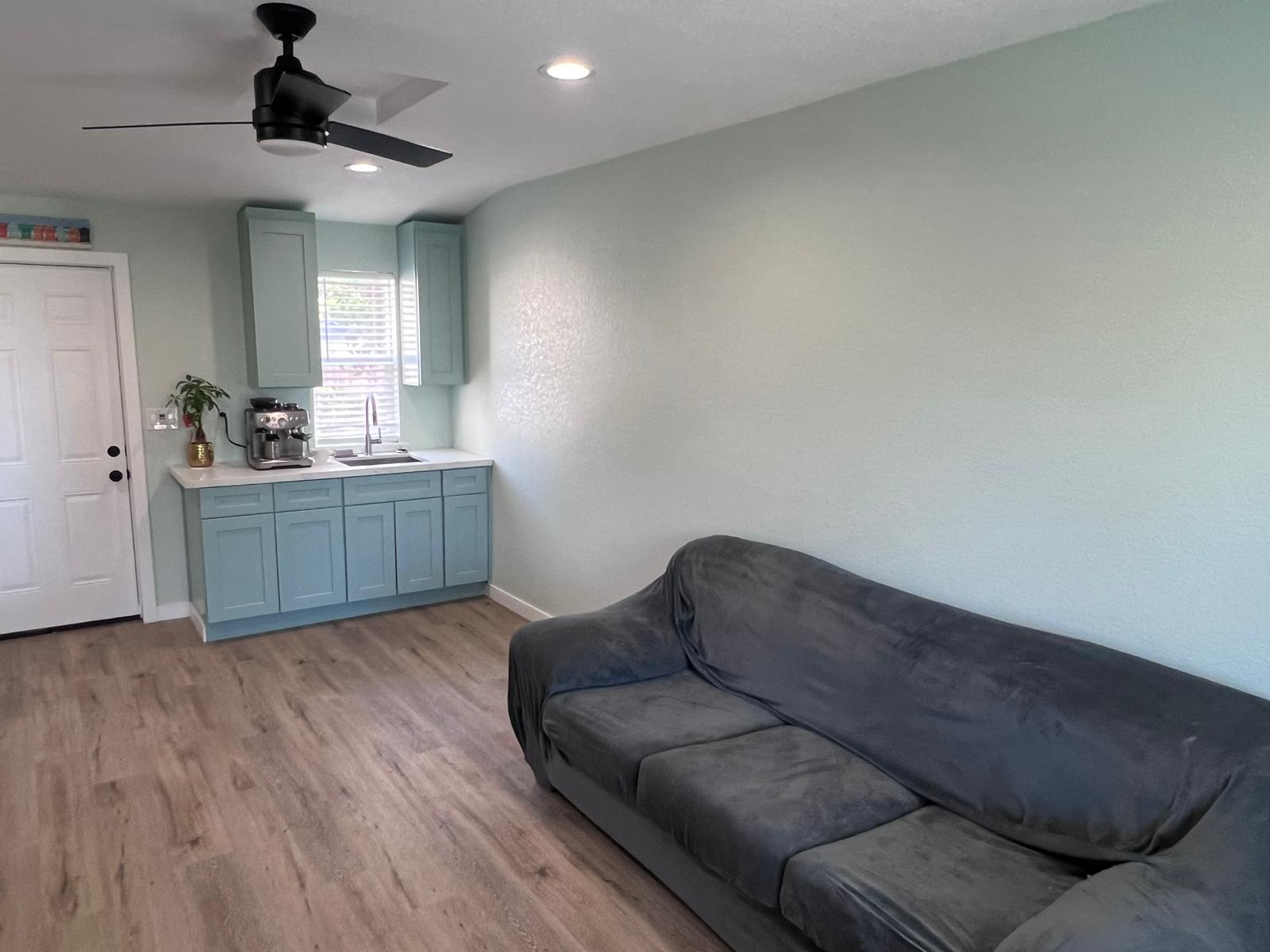
Photos of a completed two-car garage conversion, with insulation, drywall, vinyl-plank flooring and a living-room layout, are on our Sacramento garage conversion project page. For how a conversion compares with building new, see how much an ADU costs in Sacramento, and for paying for it, our ADU financing guide.
FAQ
How much does a garage conversion cost in Sacramento?
Our published starting price for a permitted garage conversion into a living unit is $108,000. The final price depends on size, how far the kitchen and bathroom sit from the sewer line, new window and door openings, and finishes.
Do I have to replace the parking if I convert my garage?
No. State law (Gov. Code 66314(d)(11)) bars the City from requiring replacement of parking lost when a garage is converted to an ADU, and Sacramento's ADU ordinance has no ADU parking requirement.
Does a garage conversion need solar panels?
The California Energy Commission treats an unconditioned garage converted to an ADU as an addition, and its solar requirement applies to newly constructed ADUs, not to additions or alterations.
Is a garage conversion cheaper than a detached ADU?
Usually. In the UC Berkeley survey of California ADUs, garage ADUs had a median cost of $90,000 against $180,000 for detached units, and the lowest cost per square foot of any type.
Can I turn my garage into a junior ADU?
An attached garage, yes: it counts as part of the house, and a JADU can be up to 500 sq ft. A detached garage can only become a full ADU.
Sources: California Government Code 66311.5, 66313, 66314(d)(7) and (d)(11), 66322, 66323 and 66333 (as in effect January 1, 2026); Sacramento City Code 17.228.105; California Energy Commission, 2025 Energy Code guidance for accessory dwelling units and 2025 ADU FAQs; City of Sacramento CDD-0250 Residential Code Requirements (2025 codes effective January 1, 2026); UC Berkeley Center for Community Innovation, "Implementing the Backyard Revolution" (April 2021), Table 2. Starting price is Result Construction's published rate as of October 2026 and excludes fees. Checked October 2026.
Garage conversions
Thinking about converting your garage?
Send us a few photos and your address. We'll check where the sewer line runs and send a written estimate for your garage.